

Direct Answer: The Destructive Link Between Poor Ventilation and Attic Mold in Pinellas
In Pinellas County's subtropical marine climate, inadequate attic ventilation is one of the most destructive yet frequently overlooked roof problems. During long Florida summers, trapped solar radiant heat drives attic temperatures to a staggering 140°F to 160°F. When high interior humidity from cooking, laundry, and air conditioning leaks migrates into a superheated, stagnant attic cavity, it creates an incubator for toxigenic mold species such as Cladosporium, Aspergillus, and Stachybotrys.
Without balanced continuous airflow—consisting of clear soffit intake vents at the eaves and unobstructed ridge exhaust vents at the peak—moisture condensates along the underside of cold plywood sheathing. Over time, this chronic moisture rots the wooden deck, delaminates plywood, rusts structural truss plates, cooks asphalt shingles from the underside, and circulates mold spores into living areas.

The Physics of Pinellas Humidity: 140°F Attic Traps and Dew Point Condensation
Many homeowners believe that attic moisture only comes from rain leaking through shingles. In reality, residential attics generate immense internal moisture vapor. An average family of four produces 2 to 4 gallons of water vapor daily through showers, dishwashers, and respiration.
In modern Clearwater homes equipped with powerful central air conditioning, ceiling drywall is kept at 72°F while the attic directly above is baking at 145°F. In unventilated attics, this extreme temperature differential pushes warm, humid air past the dew point along the cool ceiling drywall boundary and uninsulated AC ductwork, leading to condensation droplets that trigger rapid mold colonies.
Need Immediate Guidance on Your Clearwater Roof?
Speak with our local coordinator at (773) 207-0769. Open 24/7 with rapid Pinellas County response.
Soffit Baffle Blockage: The Silent Culprit Behind Mold Growth on Roof Decking
The most common structural ventilation failure discovered during our Pinellas County roof inspections is blocked soffit vents. When insulation contractors blow loose fiberglass or cellulose insulation into attics, they frequently spray insulation directly over the perimeter eave openings.
Without cardboard or plastic ventilation baffles (often called rafter chutes) installed between trusses, incoming airflow is completely choked off. Even if a roof has an expensive ridge vent along the peak, without intake air entering through the soffits, the ridge vent cannot exhaust air—creating negative pressure that draws superheated air and moisture back downward.
- Install Rigid Rafter Baffles: Placing plastic or foam chutes between rafters to guarantee an open 2-inch air channel from soffit vents into the attic.
- Maintain Clear Soffit Grilles: Periodically vacuuming dust, paint overspray, and dirt from exterior perforated soffit grilles.
- Eliminate Short-Circuiting: Never combining gable vents or motorized power fans with continuous ridge vents, which disrupts natural convective airflow.
- Seal Attic Bypass Openings: Caulking around can lights, plumbing stacks, and electrical chases in the attic floor to prevent indoor moisture leaking upward.
Thermal Imaging & Moisture Audits for Pinellas Attics
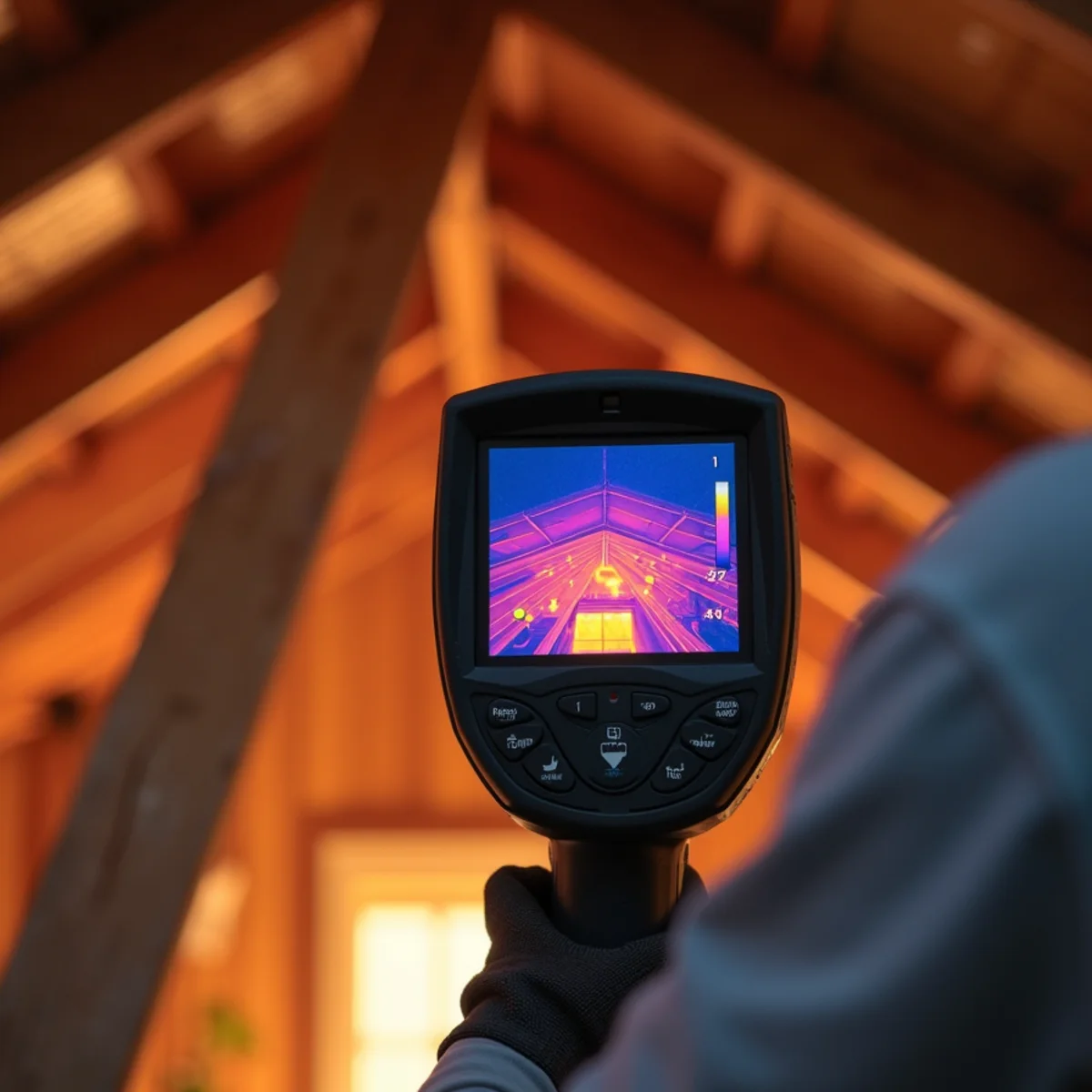
Detecting moisture and mold early requires advanced diagnostic tools rather than naked-eye inspections alone. Professional roofing inspectors use high-resolution infrared thermal imaging cameras.
Thermal imaging measures surface temperature differentials across roof sheathing, pinpointing wet insulation pockets, thermal bypass leaks, and hidden duct condensation. Paired with non-destructive pinless moisture meters, inspectors measure wood moisture content (WMC). Wood with moisture content exceeding 19% is at immediate risk of fungal decay and mold spore propagation.
Attic Ventilation Types: Efficiency and Florida Building Code Compliance
The Florida Building Code (Section R806) mandates a minimum Net Free Ventilating Area (NFVA) of 1:150 (one square foot of vent area for every 150 square feet of attic floor space), which may be reduced to 1:300 if a balanced vapor barrier and intake/exhaust ratio is maintained.
| Ventilation System | Airflow Mechanism | FBC Code Rating | Florida Pros | Florida Cons |
|---|---|---|---|---|
| Continuous Ridge & Soffit Vents | Natural thermal convection (stack effect) | Optimal (FBC Preferred) | Zero electricity cost; continuous 24/7 passive airflow | Requires balanced intake soffits to function properly |
| Off-Ridge Static Louvers | Passive exhaust through stamped metal boxes | Good for hip roofs with short ridges | Watertight baffle design; fits complex rooflines | Requires multiple units; less uniform airflow than ridge vents |
| Solar-Powered Attic Exhaust Fans | Active motorized mechanical exhaust | Supplemental only | Runs independently off sunlight; high CFM capacity | Can depressurize attic and pull conditioned air from living space |
| Traditional Gable End Vents | Passive cross-ventilation via louvers | Outdated (often creates dead airflow zones) | Easy retrofitting on older Florida ranch homes | Vulnerable to horizontal wind-driven hurricane rain intrusion |
Preventing Premature Shingle Cooking, Deck Rot, and Indoor Air Contamination
Proper attic ventilation protects your roof from premature aging. When an attic traps 150°F heat, asphalt shingles on the exterior surface are literally 'cooked' from beneath, accelerating oil volatilization and causing shingles to blister, curl, and crack in 10 to 12 years instead of their rated 20 to 25-year lifespan.
Furthermore, mold colonies growing on damp attic sheathing release millions of airborne mycotoxins. Through stack effect air currents, these spores penetrate into living areas, triggering asthma, allergies, and respiratory issues for occupants. Upgrading your ventilation system protects both your investment and your family's health.